


Bulgarian robots automate production in 30 countries across 3 continents
The Bulgarian company Spesima, whose name is an abbreviation of “specialized systems for production automation,” is one of the few in the country with more than 35 years of history. It was founded in 1989 under Decree 56 by Dr. Eng. Ventsislav Slavkov.
After the fall of the regime, Spesima entered the free market, practically starting from scratch: without its own equipment or buildings. In the early years of the transition, when industrial production in Bulgaria sharply declined, the company survived as a supplier of small machine parts for West German partners.
A turning point in the company’s history was one of its deliveries for the German firm Oskar Frech – a global leader in the production of horizontal high‑pressure aluminum die‑casting machines. The first order from Frech for the small Bulgarian company was the development of a manipulator for removing hot aluminum castings from the die‑casting machine. The project was successfully completed and marked the beginning of a long‑term partnership. In 1997, Oskar Frech decided to invest in Spesima by purchasing an equity stake, which enabled the company to accelerate its development and confidently enter international markets.
Dr. Eng. Ventsislav Slavkov recalls a curious incident from the negotiations with Frech: he included in the pricing a line item that surprised his future partners — 50,000 German marks for “know‑how.” When the owner, Mr. Wolfgang Frech, asked what stood behind this amount, Slavkov replied: “You are not buying a vegetable shop; you are buying a company that has 10 years of experience in production automation.” After a comment that the price was high, he offered a symbolic discount to 49,000 marks — an amount corresponding to the 49 percent that the German side was purchasing.
Entering global markets
This agreement transformed the company from a small office with 18 tiny rooms, where each robot was assembled in a separate space, into an established name in the sector.
To date, more than 3,500 specialized robots and peripheral devices produced by Spesima operate in over 30 countries on 3 continents. The company’s robots are used by companies such as Renault, Audi, Dacia, Danone, Sensata, Nidek, and Husqvarna, as well as by suppliers of components for BMW and ABB.
The company’s base is in Sofia and occupies approximately 4,000 square meters, including an 800‑square‑meter engineering office. Spesima’s team consists of 30 highly qualified specialists, including four PhDs in various engineering fields. The company maintains close cooperation with experts from the Technical University of Sofia and the institutes of the Bulgarian Academy of Sciences. Spesima holds more than 25 patents and trademarks for original designs created to operate in harsh conditions — high temperatures, dust, and continuous heavy workloads.
The second generation in the business
The company’s management now actively includes the second generation, represented by Ivana Slavkova‑Boteva — daughter of Dr. Slavkov. After completing her higher education in Manchester and a four‑year career in the Europe, Middle East, and Africa division of Hewlett‑Packard, she returned to Bulgaria in 2014.
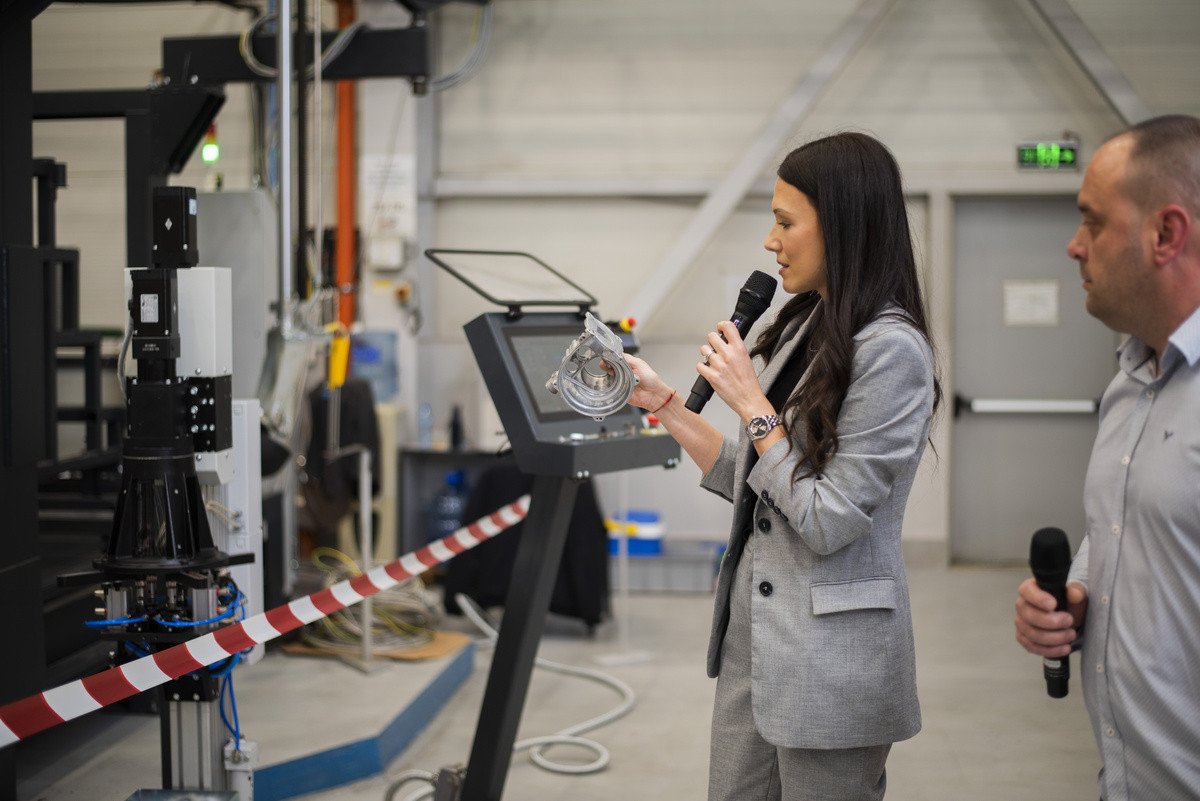
Ivana Slavkova‑Boteva is the representative of the second generation in the business
Her path to her current role as Procurator and Business Development Manager, however, has been far from easy. “When I started working at Spesima, I often had to prove that I understood my job before anyone would listen to my opinion. Sometimes it was because of my age, sometimes because I am a woman, or because I am the boss’s daughter,” Ivana shares. According to her, there were meetings where she sensed skepticism even before the conversation began, as well as moments when she was on the verge of giving up.
“Over time, I realized that respect is earned through consistency, competence, and results. Today I increasingly see women in engineering, technical, and managerial roles. In my view, the most important change is that we are gradually stopping talking about ‘women in industry’ as something unusual,” Ivana says.
She recounts one of the biggest challenges in the company’s history, although at the time she was still a student. In the period 2006–2007, the Taiwanese technology company Foxconn ordered 250 specialized robots (extractors) from Spesima for the production of laptop casings within just 18 months. Since the volume far exceeded the company’s capacity at the time, the situation required the creation of a new working model: the firm prepared the design documentation, while ten other Bulgarian enterprises manufactured 80% of the mechanical components.
This successful partnership gave rise to the Mechatronics and Automation Cluster, established jointly with the Technical University of Sofia and the Bulgarian Chamber of Commerce and Industry. According to Eng. Slavkov, the project is an example of how, when industry works together, it can accomplish major tasks at a world‑class level. The cluster continues to operate today as an organization based on mutual trust and resource sharing among companies.
Several crises later
As a global company, Spesima has not been spared from the shocks of world markets. During the 2009 financial crisis, turnover dropped to 17 times below the peak levels of 2006. Instead of mass layoffs, however, the management dismissed only seven employees in order to preserve key engineering know‑how. Dr. Slavkov’s philosophy is that during crises one must invest in assets and technologies so that when the crisis passes and economic growth returns, the company can take off with a flying start.
During this period, the company expanded its market presence in Turkey, Serbia, Korea, the USA, and China.
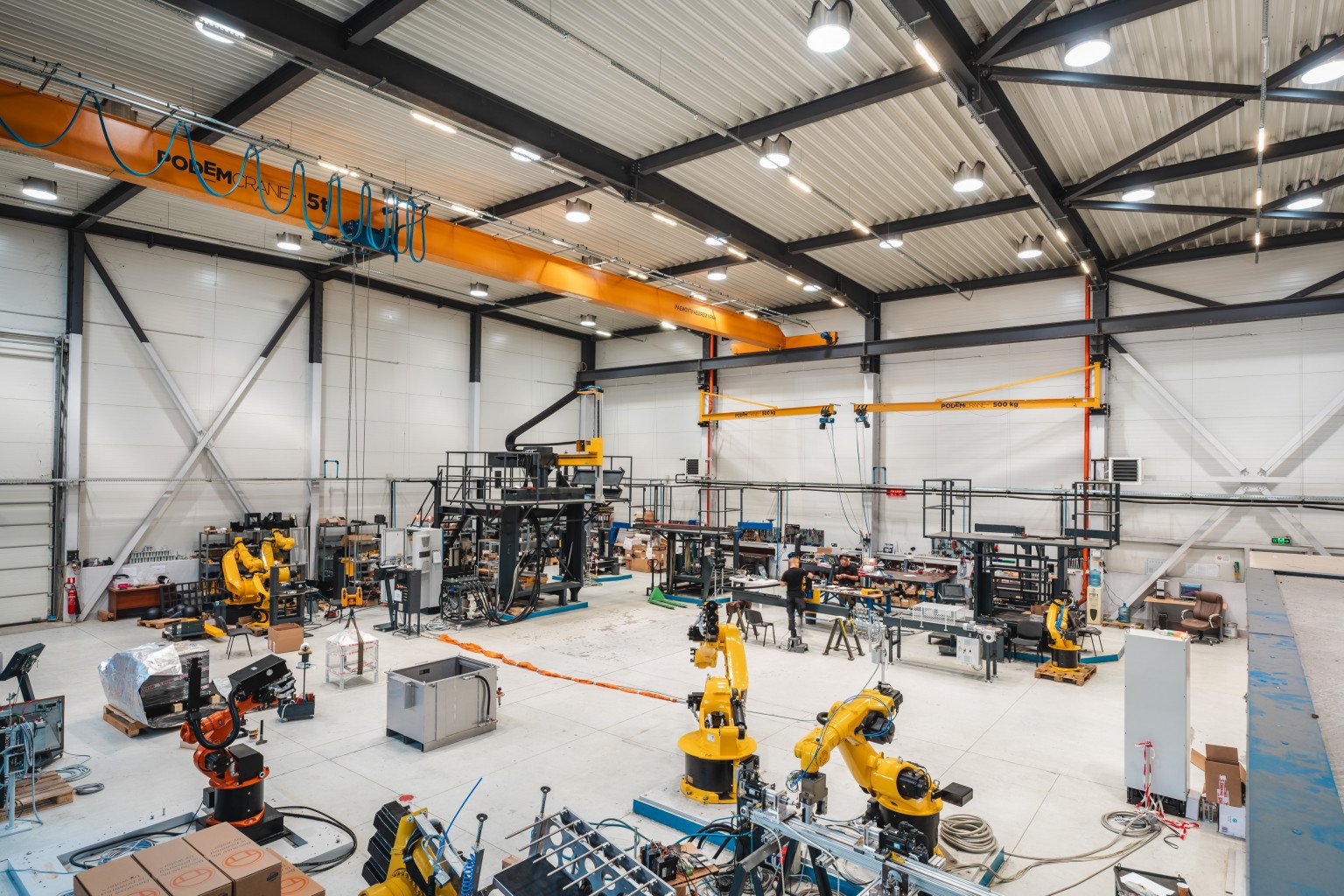
Spesima’s robots operate in more than 30 countries across 3 continents
An important direction for Spesima has become the so‑called re‑engineering of industrial robots. Instead of scrapping equipment with fully functional mechanics from major automotive plants, the team completely replaces the hardware and software, adapting their control systems to the needs of its clients. At present, more than 150 such re‑engineered robots are operating in industry, applying the principles of zero‑waste circular economy.
Beyond foundry automation
For many years, Spesima worked mainly on automation systems for the foundry industry, where machines operate under extreme temperatures and heavy dust. The accumulated experience has proven to be a solid foundation for the company to expand into other manufacturing sectors.
Today, Spesima designs and implements complex automation systems covering activities ranging from palletizing and machine tending to precision grinding, welding, and machine‑vision inspection.
Ivana Slavkova gives several examples of complex projects completed by Spesima: a system for controlling specific construction bolts, developed over a year and a half for a client in France. A robotic cell sorts mixed parts and uses three intelligent cameras to check for deformations and the presence of threading. Another specialized line, equipped with gripping devices, operates for Danone, where it automates the palletizing of yogurt cups. For a Croatian partner, the company invented an innovative dry‑ice cleaning technology for BMW components.
In these projects, the company follows a closed‑loop model: the process begins with detailed analysis and conceptual design, moves through engineering documentation and in‑house manufacturing, and concludes with programming, installation, and long‑term service support. Ivana emphasizes that this distinguishes Spesima from mass robot integrators, as the team does not offer a standalone machine but a complete solution for a specific production process.
A look into the future
In its new stage of development, Spesima is focusing on digitalization and the principles of Industry 5.0. In recent years, the company has been developing digital twins in a cloud‑based platform for modeling robotic systems in heavy industry. This enables process optimization, reduced maintenance costs, and early prevention of failures. The company is also interested in collaborative and humanoid robots, with the latter used mainly for demonstration purposes and for developing specialized software. “Despite their limited capabilities at the moment, these robots have great potential for the future,” says Spesima’s procurator.
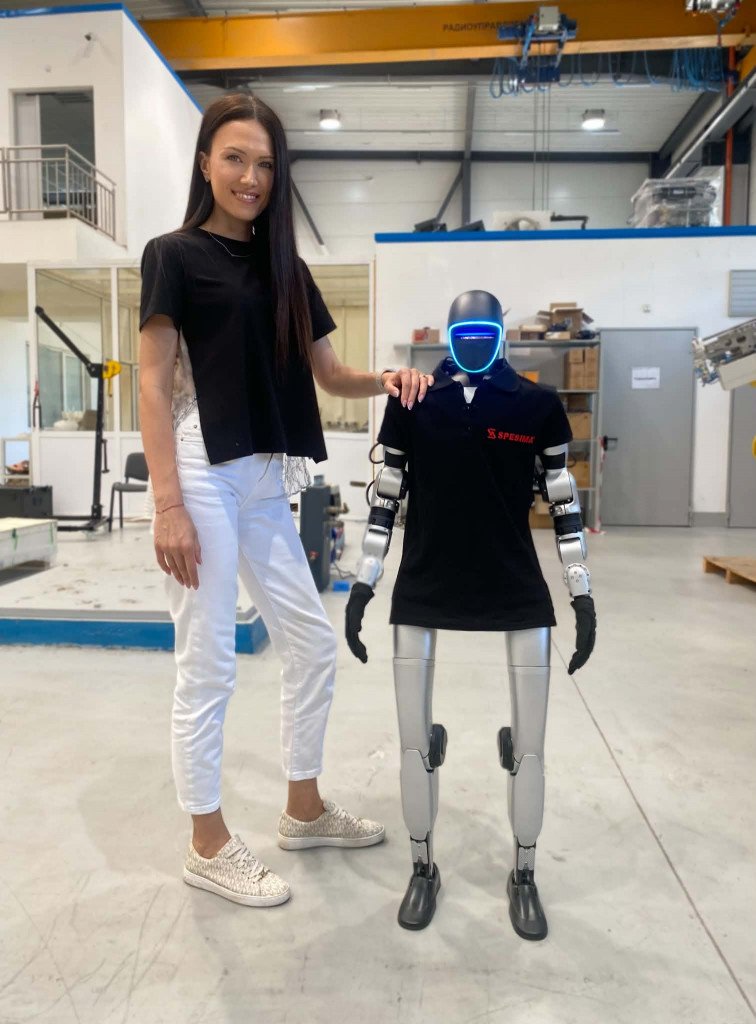
Humanoid robots have great potential in production automation
Today, the visions of the two generations at Spesima converge into a shared goal. For Ventsislav Slavkov, the dream is simple: “what I have not managed to accomplish so far, may my daughter achieve together with the team.” For Ivana Slavkova‑Boteva, the path forward lies in strengthening the company’s presence on international markets and establishing an increasingly strong position within Bulgarian industry.